
A missed call doesn't feel dramatic when you're elbow-deep in a job.
You're detailing a truck. Cutting a lawn. Fixing a leak. Cleaning a house before the client gets home. Your phone rings, you glance at it, and you think, "I'll call them back in a minute."
Then that "minute" turns into forty-five.
By the time you call back, the lead has already booked someone else. Not because they hated your business. Not because your prices were wrong. Not because your logo needed a spiritual awakening.
Because someone else answered first.
That is the $500 voicemail problem. One unanswered call can turn into a lost detail package, a landscaping quote, a plumbing repair, a recurring cleaning client, or the kind of repeat customer small businesses quietly depend on. Industry estimates put home service calls around $300–$400 per inbound call, with higher-value jobs going well beyond that. Auto repair missed-call estimates can land around $200–$500 per call, depending on the job.
So no, calling it a $500 problem isn't dramatic. It's Tuesday with a ringing phone.
And the fix is not "just answer your phone." That advice is adorable and clearly written by someone who has never held a pressure washer, pipe wrench, mower, or mop.
The fix is a missed call text back system.
What Is Missed Call Text Back?
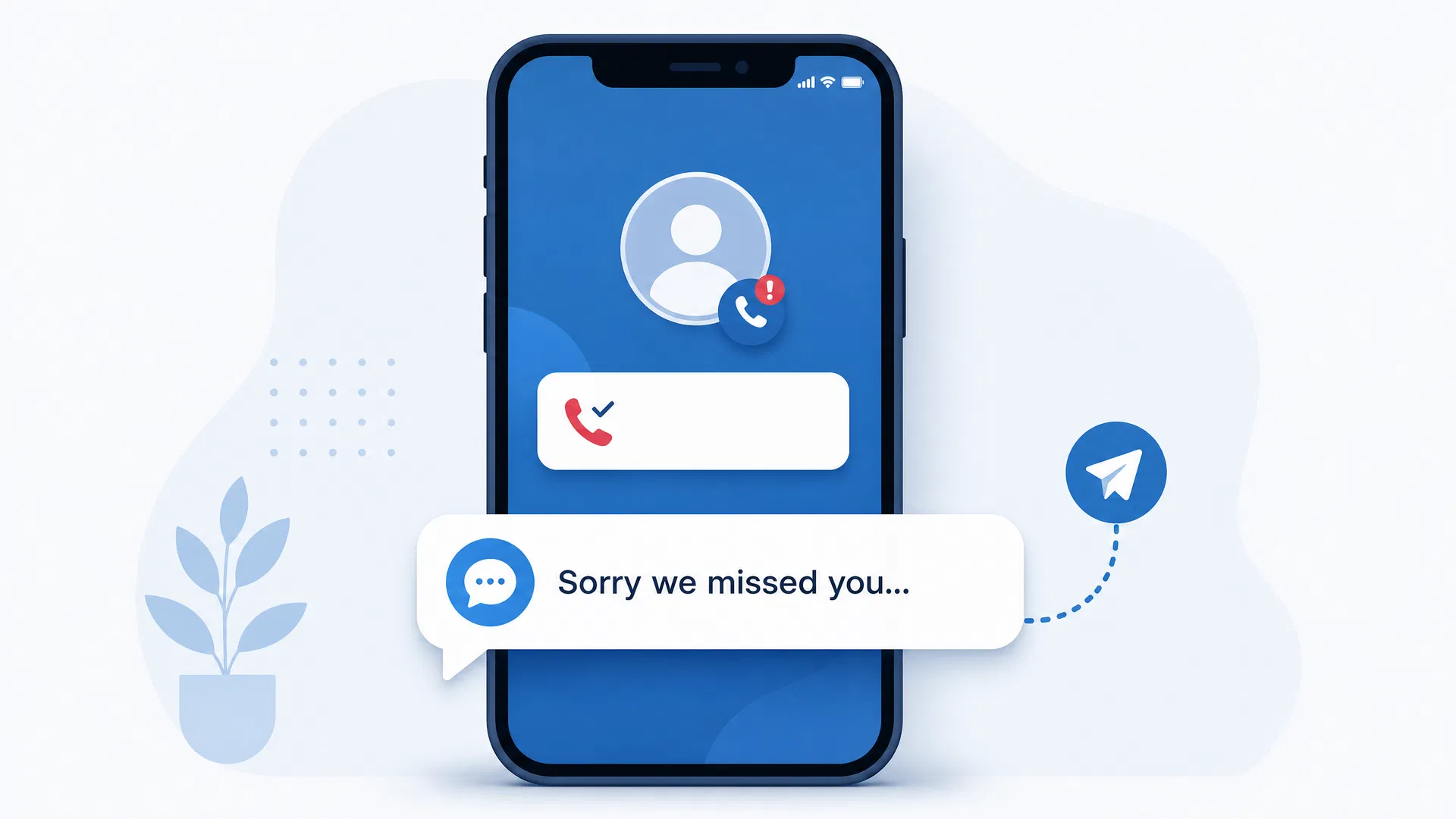
Missed call text back is an automation that sends a text message the moment an incoming call is missed. Instead of your caller hitting voicemail and wandering into the void, they immediately get a message from your business that keeps the conversation alive.
GoHighLevel describes missed-call text-back as a feature that sends an automatic SMS when an inbound call is missed. The message can be customized, tested before saving, and paired with voicemail settings inside the phone number configuration.
Here is the plain-English version:
| What Happens | Without Missed Call Text Back | With Missed Call Text Back |
|---|---|---|
| A lead calls while you are busy | They hit voicemail and may hang up | They get an instant text |
| The caller needs a fast answer | They call the next business | They can reply with what they need |
| You finish the job | You return a cold lead | You return to an active text thread |
| Your marketing paid for the call | The lead leaks out | The lead stays in your system |
This matters because most service businesses aren't losing leads from lack of talent. They're losing leads in the awkward little gap between the phone ringing and someone responding.
And that gap is expensive.
Why Voicemail Is Where Hot Leads Go to Cool Off

Voicemail used to feel normal. Now it feels like a small inconvenience wrapped in a tiny rejection.
People don't want to leave a message, wait around, and hope someone calls back. They want to know if you can fix the thing, clean the thing, quote the thing, or show up before their mother-in-law visits. The urgency is already there.
Research cited by Davinci Virtual states that about 80% of callers hang up without leaving a message when they reach voicemail or an unanswered line, and 85% never try again. Nextiva also reports that callers often move on when a business doesn't answer, and missed calls can damage trust, waste marketing spend, and erase future customer value.
That's the part people miss.
The cost is not only the first appointment. It can be the repeat detail. The monthly lawn maintenance. The annual plumbing work. The every-other-week cleaning client. The referral to the neighbor who also needs help.
A missed call isn't always one lost sale. Sometimes it's the customer relationship you never got to have.
The Real-Life Math for Local Service Businesses
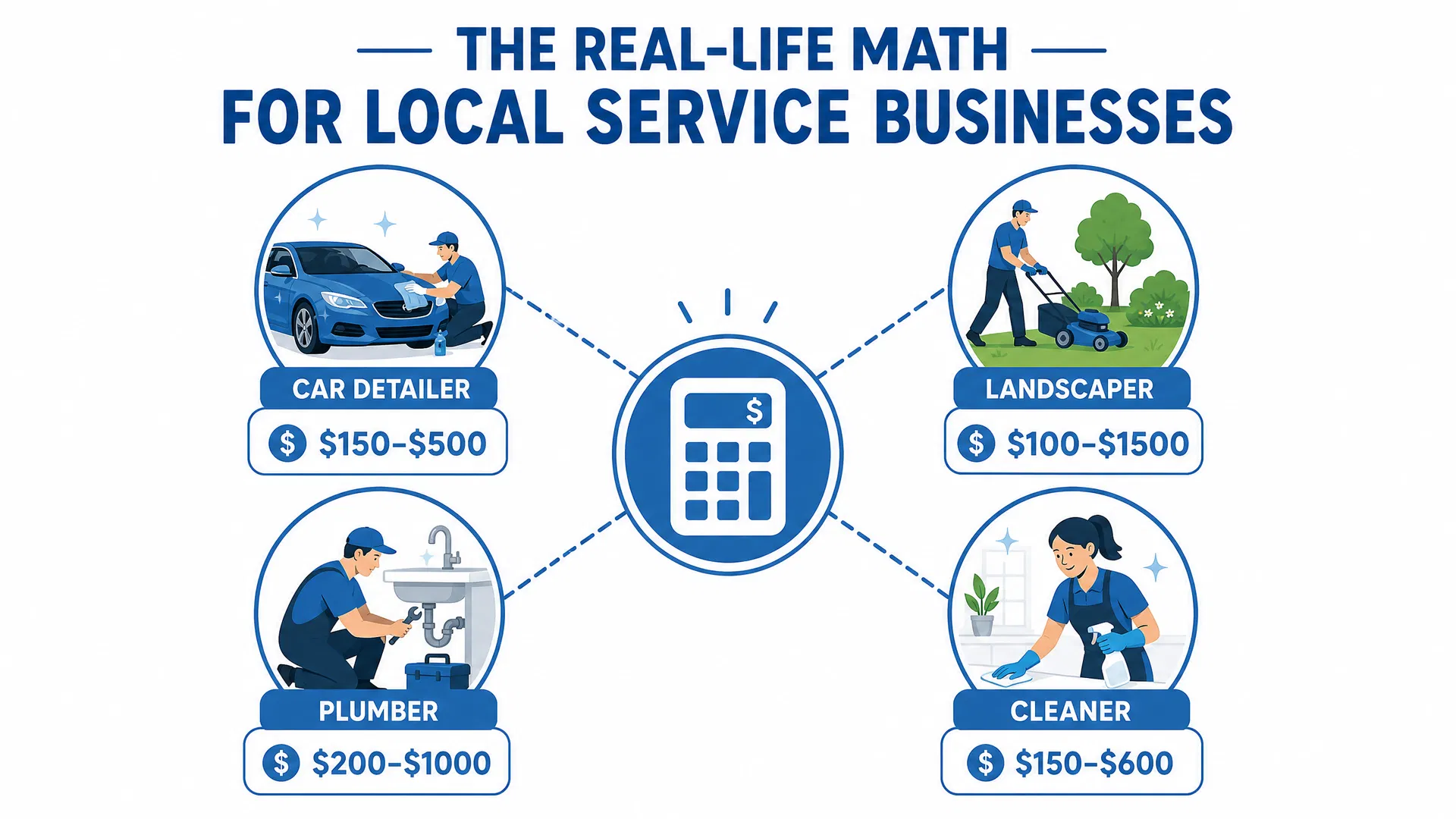
Let's make this painfully practical.
If your average job is $250 and you miss four serious calls a week, that's $1,000 in possible work sitting on the table. You won't close every lead, obviously. We're not doing fantasy spreadsheet math here. But even if you would have booked only half of them, that's still $500 a week in potential revenue.
Now stretch that across a month.
| Business Type | Common Missed-Call Scenario | Possible Job Value | Why Speed Matters |
|---|---|---|---|
| Car detailer | Caller wants an interior/exterior detail before the weekend | $150–$500+ | They are likely comparing available appointments right now |
| Landscaper | Homeowner needs a quote for cleanup, mowing, or seasonal work | $100–$1,500+ | The first responsive company often wins the estimate |
| Plumber | Caller has a leak, clog, or urgent repair | $200–$1,000+ | Emergency buyers don't wait patiently for voicemail callbacks |
| Cleaner | Caller wants a deep clean, move-out clean, or recurring service | $150–$600+ | If they are planning around a date, they need confirmation fast |
This is why missed-call automation isn't just a "nice little feature." It's a lead protection system.
You paid for the website. The Google Business Profile. The Facebook posts. The referrals. The yard signs. The ads. The whole little circus.
Then the call finally comes in and lands in voicemail?
No. Absolutely not. We're not feeding hot leads to the voicemail goblin.
How Missed Call Text Back Works in GoHighLevel
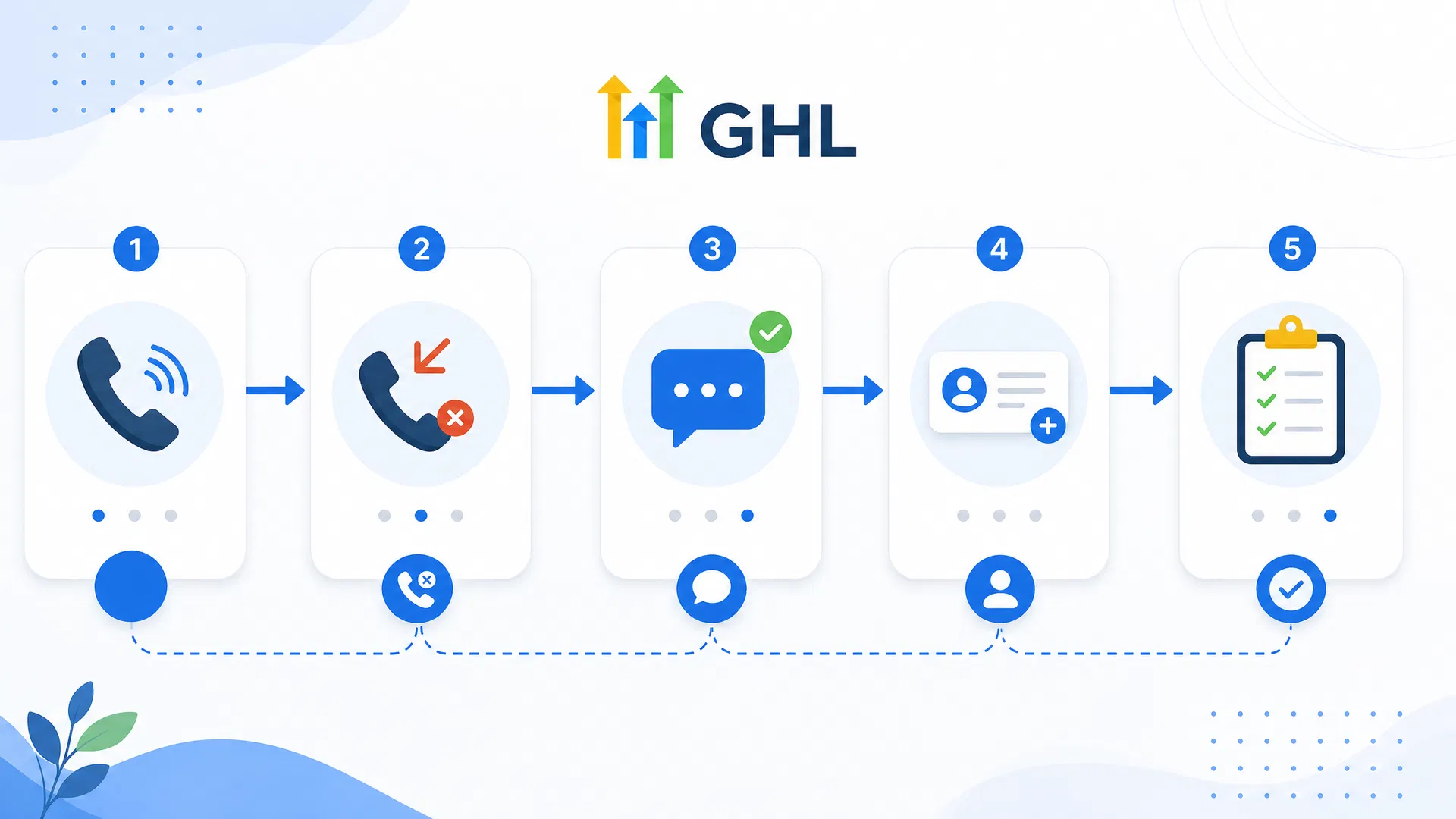
In GoHighLevel, you can configure missed-call text-back under the phone number settings. The basic setup is simple: choose how long the phone should ring before the missed-call action triggers, turn on missed-call text-back, customize the SMS, send a test, and save it.
HighLevel notes that the incoming call timeout is commonly set around 10–20 seconds, depending on the setup. That means the system waits long enough for you to answer if you can, but not so long that the caller has already mentally packed up and left.
Here's what actually matters in the setup:
| Setup Element | What It Does | ConnectCraft Note |
|---|---|---|
| Ring timeout | Decides when the call counts as missed | Don't make people wait forever. That's not suspense; it's friction. |
| Custom SMS | Sends an instant reply to the missed caller | Make it sound like your business, not a parking ticket. |
| Optional voicemail audio | Lets you use a branded voicemail greeting | Helpful if you want the call experience to feel consistent. |
| Test send | Shows how the message appears before it goes live | Always test. "Oops" is not a strategy. |
| Workflow waits or filters | Prevents repeated texts if someone calls multiple times | This matters because HighLevel can send a text for every missed call. |
That last point is big.
HighLevel's help documentation says the feature can trigger an SMS notification for every missed call, including when the same person calls multiple times within a short period. That's useful, but it needs a little common sense. If someone panic-calls three times in five minutes, you probably don't want to send three identical texts like a needy robot with boundary issues.
A good workflow can add a wait step, apply a tag, or filter repeat callers so the system feels helpful instead of spammy.
That's the difference between automation that saves the lead and automation that makes the lead wonder if your business phone is possessed.
What Should Your Missed Call Text Say?
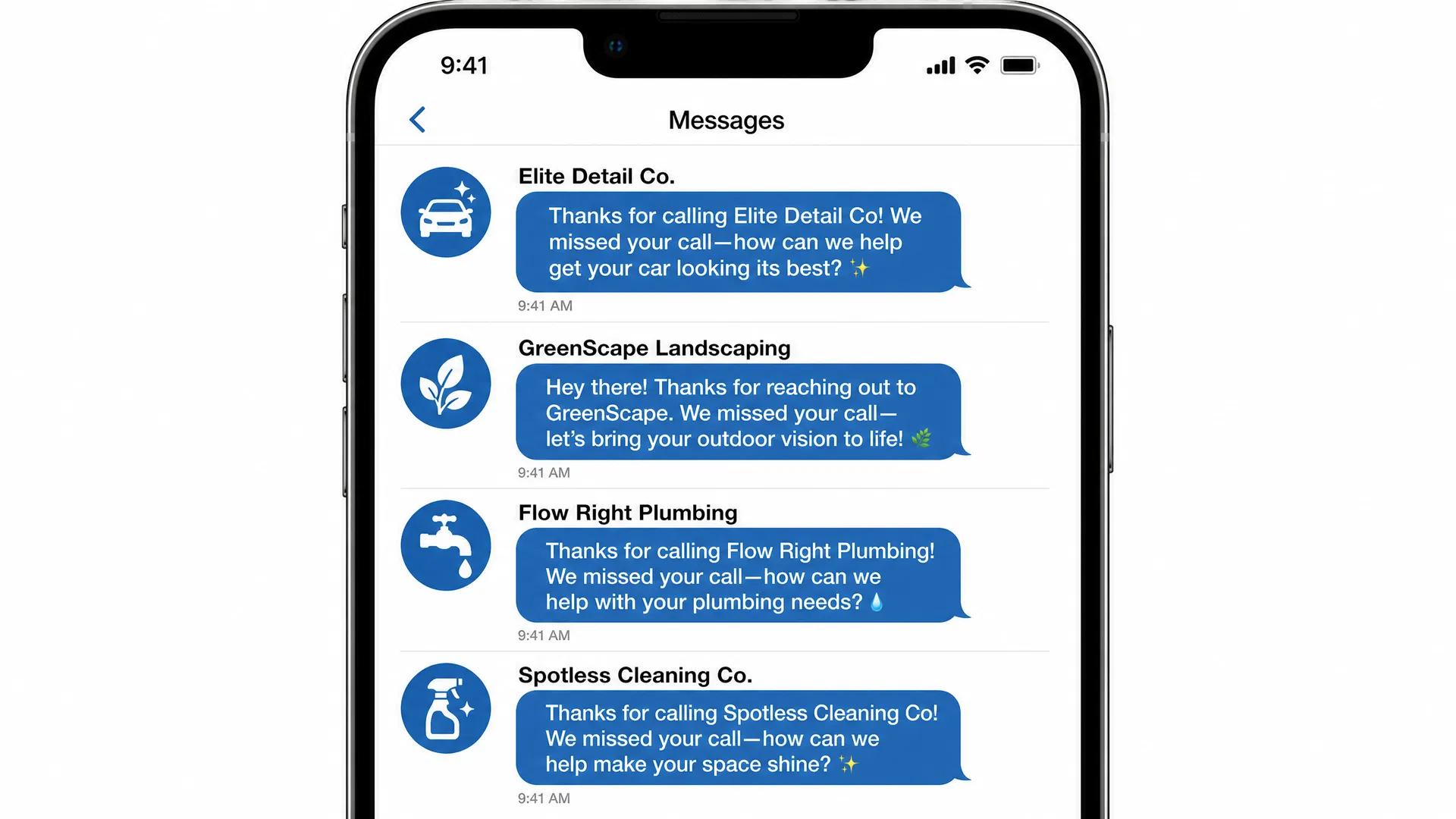
The best missed-call text is short, specific, and easy to reply to. It should confirm that you saw the call, invite the person to text back, and give them the next step.
It doesn't need to be clever. It needs to work. Tiny difference. Massive impact.
Here are a few starter messages for local service businesses:
| Business | Missed Call Text Example |
|---|---|
| Car detailer | "Hey, sorry we missed your call. Text us your vehicle type and what you need done, and we'll help you find the next available detail spot." |
| Landscaper | "Sorry we missed you. Reply with your address and what you need help with — mowing, cleanup, mulch, or a quote — and we'll get back to you shortly." |
| Plumber | "Sorry we missed your call. If this is urgent, reply with what's going on and your address. We'll respond as soon as possible." |
| Cleaner | "Sorry we missed you. Text us what type of cleaning you need and your preferred date, and we'll help with availability." |
Notice what these messages don't say: "Your call is very important to us."
That sentence has been emotionally unemployed since 2009.
Your missed-call text should sound like a real business owner or team member wrote it. This is where ConnectCraft's Voice-First AI approach matters. The automation is doing the sending, but the message should still sound human.
Zero Robots Allowed. Your Voice, Automated.
A Missed-Call System Is Not a Replacement for Follow-Up
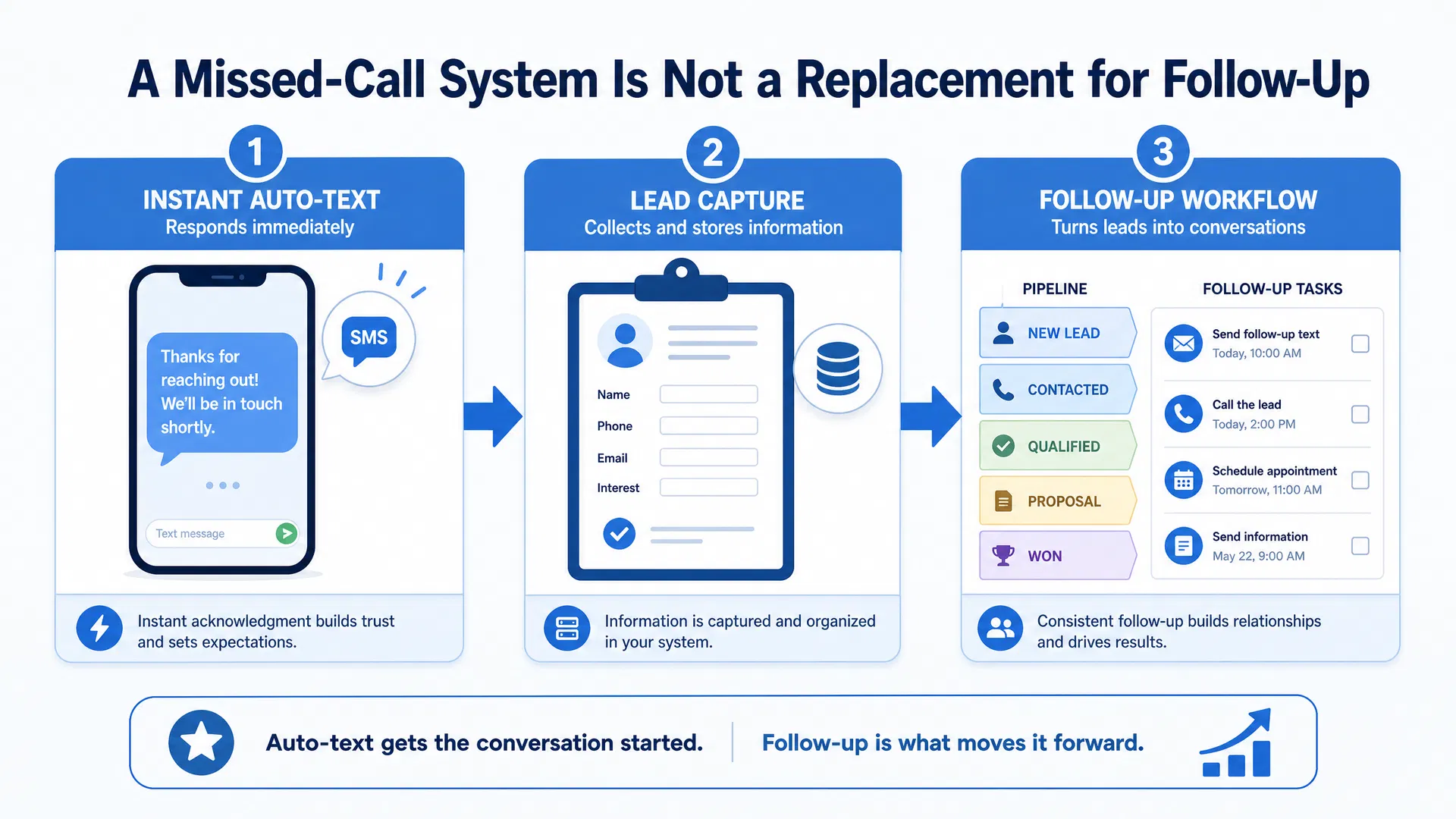
Let's be honest. Missed-call text-back won't magically close the job while you keep working and never look at your phone again.
It buys you time.
And time is exactly what most service business owners are missing.
When someone receives an instant text, they know the business is active. They have an easy way to explain what they need. You have a written thread to return to. If your CRM is set up properly, that lead can be tagged, tracked, assigned, or moved into a follow-up pipeline instead of living in the sad little "recent calls" list on your phone.
The text keeps the door open. Your follow-up still has to walk through it. Rude, I know, but true.
A strong missed-call workflow usually includes three layers:
| Layer | Purpose | Example |
|---|---|---|
| Instant response | Keeps the caller engaged | Auto-text after the missed call |
| Lead capture | Gets the job details | Ask for address, service type, urgency, or preferred time |
| Follow-up workflow | Prevents the lead from being forgotten | Reminder, pipeline stage, task, or second text if no reply |
This is why I don't treat missed-call text-back as a random feature. It belongs inside a bigger Never Miss a Lead System.
You don't need to do it all. You just need the right system.
Common Mistakes That Make Missed Call Text Back Annoying
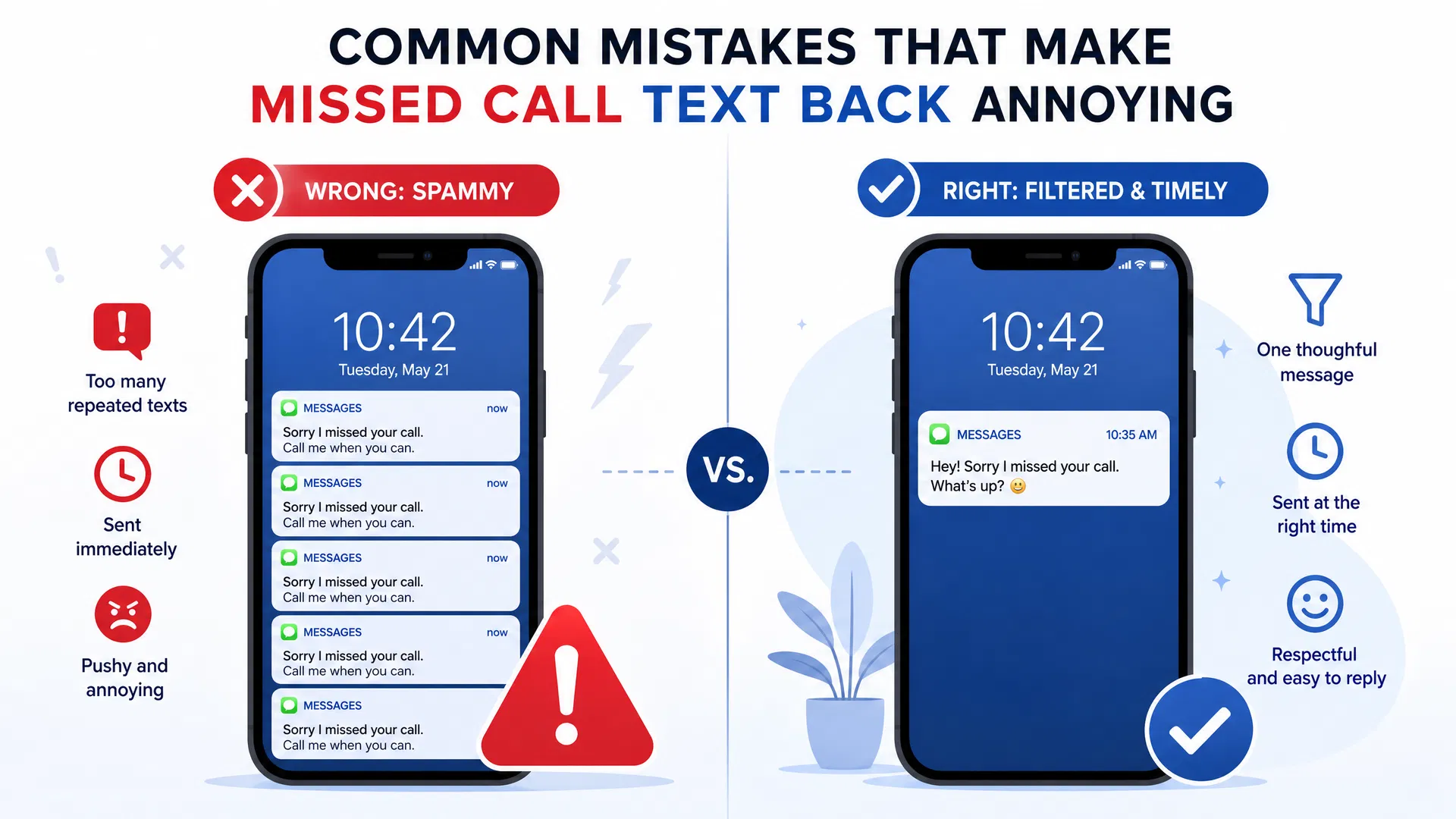
Missed-call text-back is simple, but simple doesn't mean "set it up while distracted and hope the tech fairies handle it."
The first mistake is sending a message that sounds cold or generic. If your text reads like it escaped from a software demo, people feel that. A plumber's missed-call text should not sound like a SaaS onboarding email. A cleaner's message should not sound like a legal notice.
The second mistake is failing to throttle repeat messages. Since missed-call text-back can fire for repeated missed calls, you need workflow logic that prevents accidental SMS spam.
The third mistake is asking for too much too soon. Don't make the caller fill out a whole application by text. Start with the next useful detail.
The fourth mistake is not testing the message from the customer's side. Send the test. Look at the sender number. Check the wording. Make sure the reply path works. This is the tiny boring step that prevents public-facing weirdness. We love tiny boring steps. They keep businesses from looking chaotic.
Who Needs Missed Call Text Back Most?
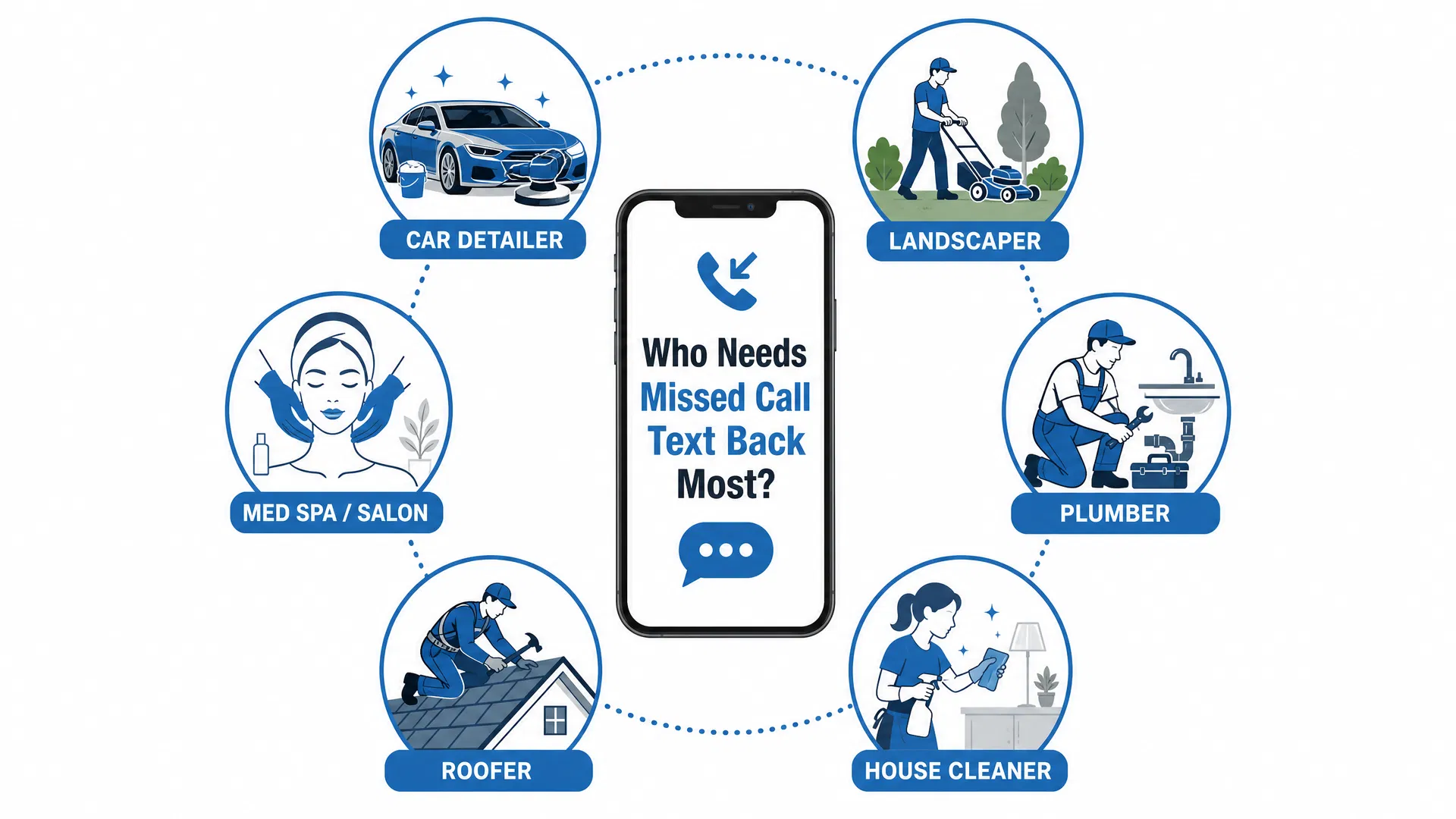
Any business that gets calls can benefit from faster response, but missed-call text-back is especially useful for owners who cannot drop everything every time the phone rings.
That includes car detailers, landscapers, plumbers, cleaners, roofers, electricians, mobile service providers, med spas, salons, and small local teams living in the very annoying space between "we need every lead" and "we can't hire a full-time receptionist yet."
Here's the real test: if a missed call could reasonably become a booked job, you need a plan for that missed call.
Not a guilty feeling. Not a sticky note. Not "I'll remember later," because no, you will not. You're running a business, not auditioning for a memory championship.
You need the system to catch the lead while it's still warm.
How to Set Up a Better Missed-Call Text Back Workflow
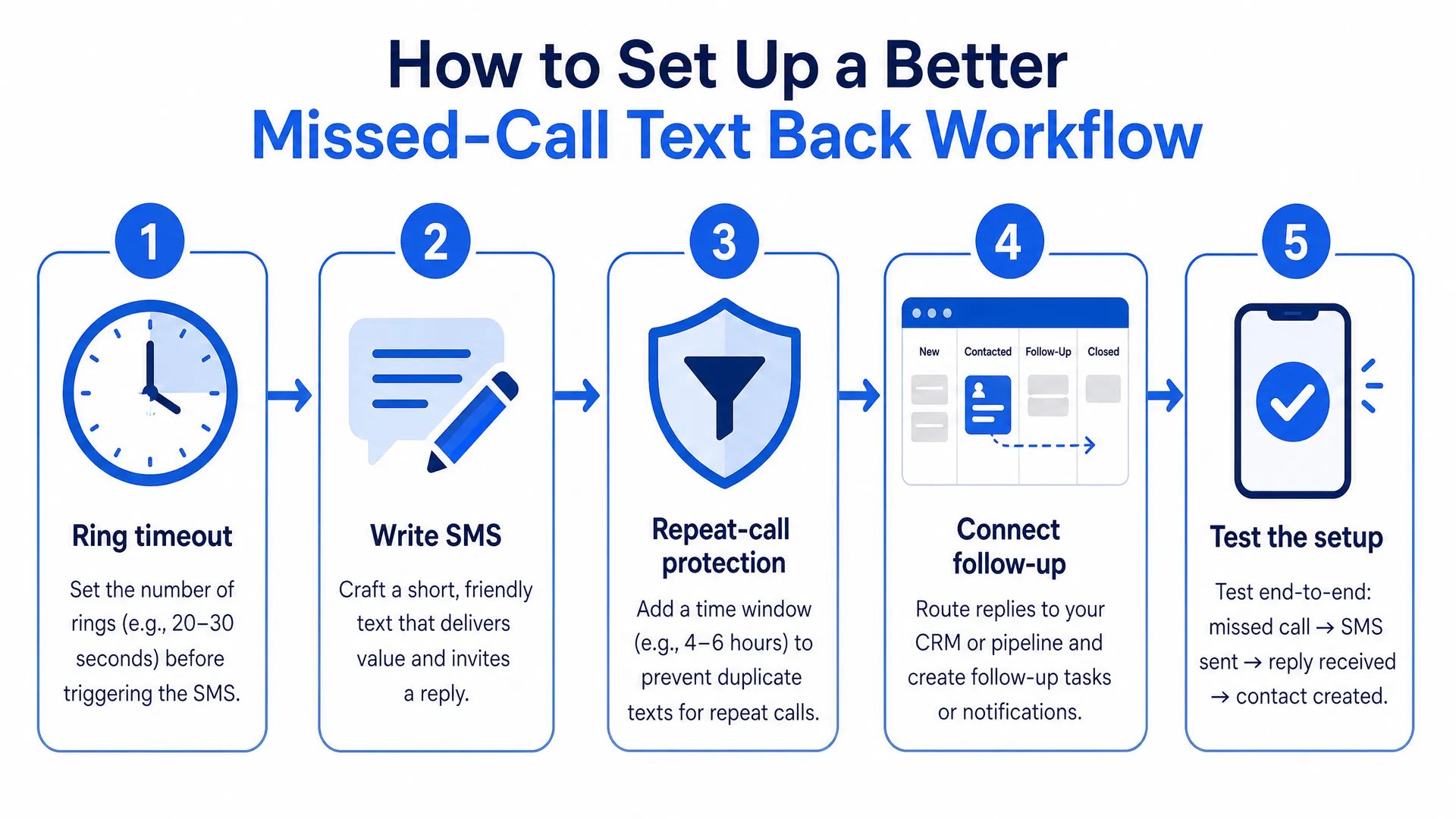
Here's the practical version I'd actually build for a service business using GoHighLevel or a similar CRM.
First, decide your ring timeout. If you're usually near your phone, 15–20 seconds may give you enough time to answer. If you're usually hands-on with clients or equipment, a shorter timeout may make sense. The goal is to respond quickly without cutting off your chance to pick up.
Second, write a message that matches your business voice. Keep it short. Include the service-specific next step. Ask for the one detail that helps you respond faster.
Third, add repeat-call protection. A wait step or filter can stop the system from sending the same text every time the caller retries.
Fourth, connect the reply to your follow-up process. That might mean a pipeline, notification, task, tag, or manual callback list. The automation should not just text the lead. It should help you work the lead.
Fifth, test the whole thing. Call the number. Let it miss. Check the text. Reply to it. Make sure it lands where you expect.
That's the difference between "we turned on a feature" and "we fixed a lead leak."
FAQ
What is missed call text back?
Missed call text back is an automation that sends an SMS when an inbound call is missed. It gives the caller an immediate response, even when no one can pick up the phone. The goal is simple: keep the lead warm long enough for a real follow-up.
How much does one missed call cost a small business?
The cost depends on your industry, average job size, and close rate. Home service calls are often estimated around $300–$400 per inbound call, and some missed calls can represent much higher-value jobs. For many local service businesses, one missed call can absolutely turn into a few hundred dollars in lost work.
Does GoHighLevel have missed call text back?
Yes. GoHighLevel includes missed-call text-back settings under phone number advanced settings. You can set the ring timeout, enable missed-call text-back, customize the SMS, optionally upload voicemail audio, send a test, and save the configuration.
Will missed call text back send too many texts?
It can if you don't configure it carefully. HighLevel notes that missed-call text-back can trigger for every missed call, including repeated calls from the same number in a short time. Use workflow waits, tags, or filters so your helpful automation doesn't become a clingy ex.
What should my missed call text message say?
A good missed-call text should acknowledge the missed call, invite the person to reply, and ask for the next useful detail. For example: "Sorry we missed your call. Reply with what you need help with and your address, and we'll get back to you shortly." Short. Useful. Not written by a toaster.
Is missed call text back better than voicemail?
It's not always a full replacement, but it's usually a stronger first response. Many callers don't leave voicemail and may contact a competitor instead. A text gives them a faster, easier way to keep the conversation going.
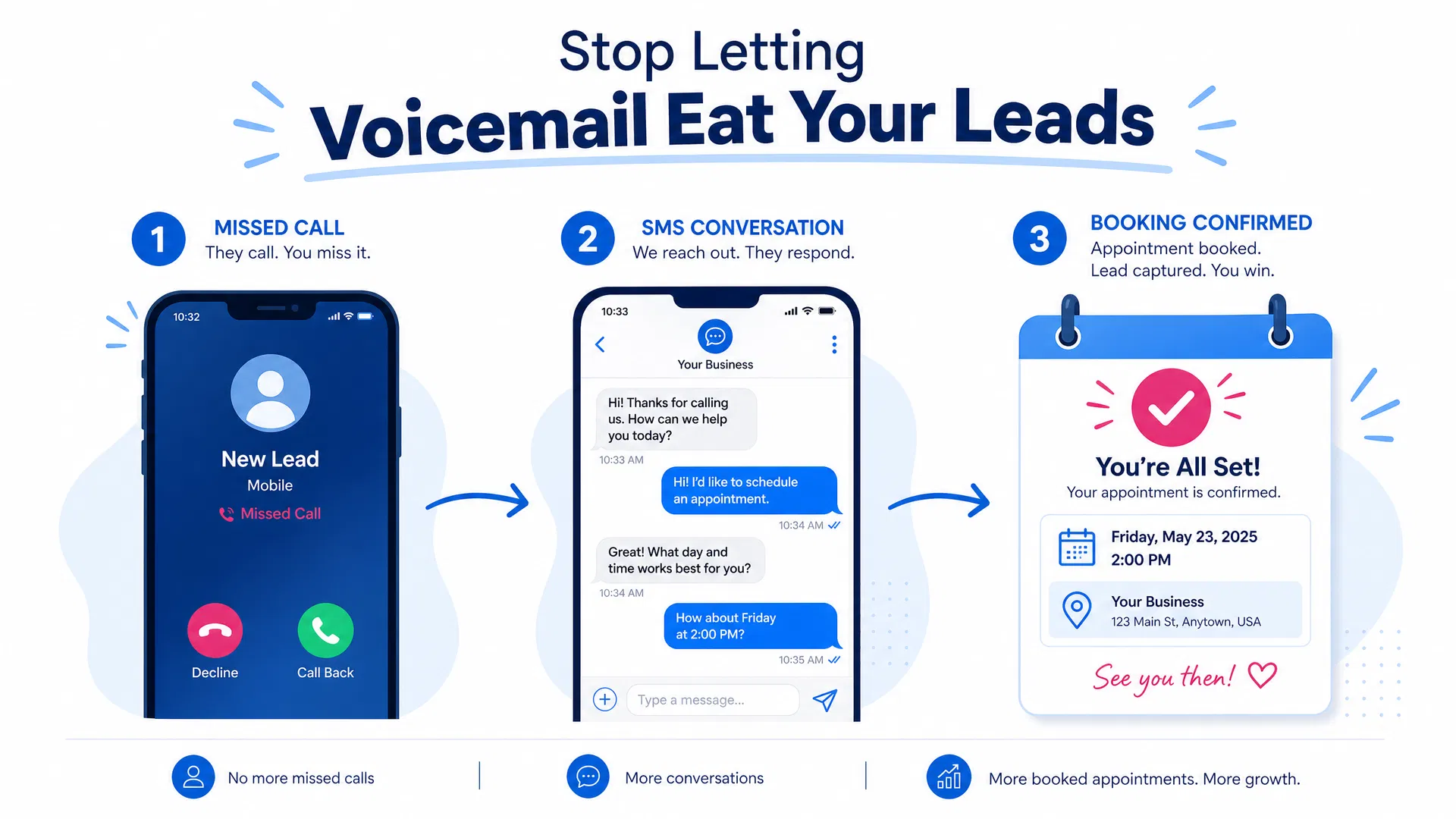
Missed calls happen. You're not a bad business owner because you couldn't answer while doing the actual work people pay you for.
But if those calls keep turning into lost jobs, the system needs to change.
A missed-call text-back setup gives every caller an immediate response, keeps the lead from cooling off, and gives you a better shot at booking the job when you come up for air.
Stop missing calls. Let's look at your setup.
About the Author: Sarah Nayes is the founder of ConnectCraft AI & Automation Solutions, where she helps entrepreneurs build AI-powered systems that actually sound human. A self-taught entrepreneur and Voice-First AI advocate, Sarah helps coaches, consultants, and small business owners simplify their marketing, fix their follow-up, and stop losing leads without losing their authentic voice.
Stop losing jobs to voicemail.
Super Agent answers every call, texts back every missed one, and books the job. $500/mo, no contract.
See Super Agent →