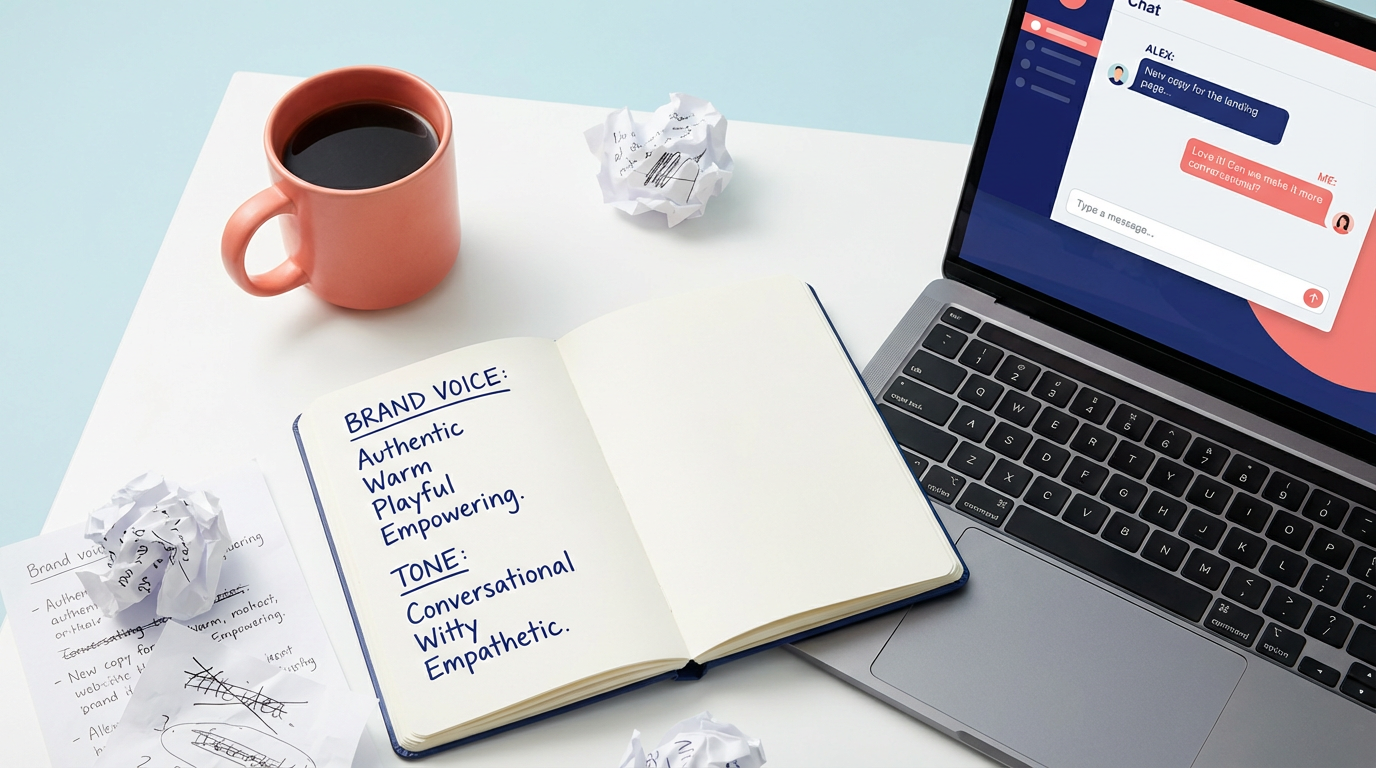
Asking ChatGPT to "make it engaging" is like handing someone a plain rice cake and saying, "Make it gourmet."
Technically possible. Spiritually questionable.
The problem is not that ChatGPT can't help you write better content. It can. OpenAI's own prompt guidance says better outputs come from specific, descriptive instructions about context, outcome, format, and style. The problem is that most people give AI a vague personality sticker and expect a full brand voice to walk out wearing cute shoes.
That's how you end up with posts that are accurate, polished, and completely forgettable.
If your AI-generated content sounds like everyone else's, you don't need a better "make this engaging" prompt. You need a real ChatGPT brand voice system. One that tells AI what you believe, how you talk, who you're talking to, what you refuse to sound like, and where the human judgment still belongs.
AI isn't the problem — it's how you're using it.
Why "Make It Engaging" Gives You Generic AI Content

"Engaging" is not a direction. It's a wish.
ChatGPT does not know whether engaging means funny, blunt, emotional, educational, rebellious, warm, skeptical, faith-centered, founder-led, nerdy, minimalist, or "please sound like I've had coffee and a personality." So it guesses. And because AI models are trained on enormous amounts of internet text, the guess often lands in the safest possible middle.
That middle has a sound. It says things like "in today's fast-paced world." It uses "unlock," "elevate," and "transform" like it gets paid per cliché. It writes paragraphs that are technically correct but emotionally beige.
That beige content creates a trust problem. Google's people-first content guidance asks whether a page provides original information, meaningful value compared with other search results, and enough useful depth that readers feel satisfied. Generic AI content struggles with that because it often summarizes the obvious instead of adding perspective.
Here's the uncomfortable truth: brand voice is not decoration after the draft is done. It is the input that should shape the draft from the beginning.
| Weak Prompt | Better Brand Voice Direction |
|---|---|
| "Make this engaging." | "Rewrite this for overwhelmed non-technical coaches. Keep it direct, lightly snarky, practical, and reassuring. Use short paragraphs, plain language, and one specific example." |
| "Make it sound more human." | "Remove corporate phrases, add contractions, vary sentence length, and keep the tone like a smart friend explaining this over coffee." |
| "Use my brand voice." | "Use our voice rules: confident not arrogant, funny not forced, helpful not hypey. Avoid these banned words. Mirror these three sample posts." |
If you want better AI output, stop treating brand voice like a final sprinkle. Build it into the recipe.
Element 1: A Point of View Strong Enough to Recognize

A real brand voice starts with a point of view. Not a niche. Not a tagline. Not three adjectives you picked because they looked nice in a Canva template.
A point of view is what your brand believes that someone else might not say out loud. It gives your content a spine. Without it, ChatGPT fills the silence with whatever the internet has collectively agreed sounds professional enough.
For ConnectCraft, one core point of view is simple: AI should be your assistant, not your replacement. That belief changes how we talk about tools, prompts, automation, content, and voice. We do not treat AI like magic glitter. We treat it like a powerful assistant that needs training, boundaries, and a human with actual taste in charge.
| Brand Voice Question | What AI Needs to Know |
|---|---|
| What do you believe that your audience needs to hear? | The perspective your content should reinforce again and again. |
| What common advice do you disagree with? | The myths your content should challenge. |
| What problem do you solve differently? | The angle that makes your content sound like you, not your competitor. |
| What should readers feel after reading your content? | The emotional job your voice has to perform. |
That gives ChatGPT something to stand on. And yes, this matters even when you are writing a "simple" social post. Especially then. Short content exposes weak voice fast.
Element 2: A Clear Audience Relationship

Voice changes depending on the relationship. You do not talk to your best friend the same way you talk to a judge, a toddler, a client in crisis, or the person who says "let's circle back" unironically.
The same is true for brand voice. If ChatGPT does not understand the relationship between you and your audience, it will default to generic teacher mode. That is where you get stiff educational content that explains everything like the reader just discovered the internet yesterday.
For many coaches, consultants, and service providers, the strongest voice is not "expert on a pedestal." It is smart guide beside the reader. You know more about the topic, but you are not talking down to them. You are translating the mess into something usable.
| If Your Relationship Is... | Your Content Should Sound... | Your Content Should Avoid... |
|---|---|---|
| Trusted guide | Clear, calm, practical, reassuring | Condescending explanations |
| Smart friend | Conversational, direct, lightly funny | Over-polished corporate phrasing |
| Specialist | Specific, confident, grounded in examples | Vague hype and fake certainty |
| Coach | Encouraging, action-oriented, honest | Motivational poster energy |
A useful ChatGPT brand voice guide should include who the reader is, what they are worried about, what they already know, and what they are tired of hearing. That is how you get content that feels relevant instead of randomly "engaging."
Element 3: Language Rules That Go Beyond Tone Adjectives

"Friendly, professional, and approachable" is not a brand voice guide. It is a dating profile for a bank.
Tone adjectives can help, but they are too fuzzy on their own. AI needs concrete language rules. That means words you use, words you avoid, phrases that sound like you, and phrases that need to be dragged gently into the trash.
| Brand Voice Component | Weak Version | AI-Ready Version |
|---|---|---|
| Tone | "Sound friendly." | "Sound like a smart friend who tells the truth kindly, with occasional dry humor." |
| Vocabulary | "Avoid jargon." | "Avoid: leverage, unlock, elevate, seamless, robust, delve. Use plain verbs like use, build, fix, write, save, teach." |
| Signature phrases | "Mention our tagline." | "Use 'Build smarter. Sound human. Save hours.' only where it naturally supports the point." |
| Examples | "Make it like our brand." | "Mirror the rhythm of these three approved posts. Notice the short openings, contractions, and practical examples." |
Your brand voice guide should tell ChatGPT what to do instead of only what not to do. "Don't sound robotic" is less useful than "Use contractions, cut filler, keep paragraphs under three sentences, and include one practical example before moving to the next point."
Element 4: Rhythm, Cadence, and Sentence Shape

Brand voice is not only word choice. It is rhythm.
Some brands write in tight, punchy lines. Some use longer, reflective paragraphs. Some sound like a coach with a whiteboard. Some sound like a founder sending a voice memo from the school pickup line. Both can work. The problem starts when every AI-generated paragraph has the same shape.
You have seen it. A medium-length paragraph. Then another medium-length paragraph. Then a three-item list. Then a sentence that starts with "This means." Then a conclusion that politely repeats everything you just read. That rhythm screams AI.
| Generic AI Rhythm | Stronger Human Rhythm |
|---|---|
| "Brand voice is an important part of creating content that resonates with your audience and helps establish consistency across platforms." | "Brand voice is why people recognize you before they see your logo." |
| "By implementing a clear set of guidelines, businesses can improve the quality of AI-generated content." | "Give AI rules it can actually follow. Your future self will spend less time rage-editing." |
| "It is important to maintain authenticity when using AI tools." | "Do not automate the part your audience trusts you for." |
Use short openings. Vary sentence length. Keep paragraphs to one to three sentences. Use a direct, conversational rhythm. Avoid symmetrical AI structure where every section has the same intro, list, and recap. Read like a person explaining something useful, not a brochure trying to win an award no one asked for.
That one paragraph can save you from a lot of "technically fine, emotionally dead" content.
Element 5: Proof, Boundaries, and Human Judgment

Real brand voice is not just personality. It is trust.
If your content is funny but unsupported, it is noise with jokes. If it is polished but vague, it is a brochure in witness protection. If it sounds human but says nothing original, readers still leave.
| Brand Voice Area | What to Define |
|---|---|
| Proof style | Do you use examples, stories, client patterns, data, screenshots, frameworks, or plain-language breakdowns? |
| Claim boundaries | What should AI never exaggerate, promise, diagnose, guarantee, or invent? |
| Human review rules | Which content needs your final approval because tone, emotion, or accuracy matters too much? |
| Experience markers | What founder stories, client experiences, or practical lessons can AI reference honestly? |
This matters because ChatGPT can produce a smooth sentence faster than most of us can find our coffee. Smooth does not mean true. Smooth does not mean strategic. Smooth definitely does not mean on-brand.
Human judgment is part of the system. Not because AI is bad. Because your lived experience, taste, ethics, audience knowledge, and timing are not optional extras. Use AI to draft, organize, repurpose, and pressure-test. Do not use it to outsource your standards.
The 5-Part Brand Voice Prompt ChatGPT Actually Needs

If you want ChatGPT to write closer to your real voice, give it the five elements before you ask for the draft.
Brand Voice Prompt Template
You are writing for [brand/business name]. Our point of view is [belief or contrarian stance]. Our audience is [specific reader] who feels [pain/frustration/desire] and wants [outcome]. Our relationship to them is [trusted guide/smart friend/specialist/coach]. Use this language style: [specific words, sentence rhythm, tone, examples]. Avoid these words and patterns: [banned phrases, clichés, structural habits]. Use proof through [examples, stories, data, frameworks]. Do not exaggerate, invent results, or make claims we cannot support. Write [asset type] about [topic] with [format/length/CTA].
Now compare that to: "Make this more engaging." See the issue? One is a system. The other is a shrug in prompt form. A better prompt does not need to be complicated. It needs to be specific enough that AI can stop guessing and start assisting.
Quick Brand Voice Audit Before You Prompt AI

Before you ask ChatGPT to write another post, run this quick audit.
| Question | Why It Matters |
|---|---|
| Could someone recognize this as ours without the logo? | Recognition is the point of brand voice. |
| Does this include a real point of view? | Generic content usually avoids taking a stand. |
| Does it sound like how we actually talk? | If you would never say it, do not publish it. |
| Are there concrete language rules? | AI needs examples, not vibes. |
| Does the rhythm feel human? | Repetitive paragraph structure is one of the fastest AI tells. |
| Is there proof behind the claims? | Trust comes from substance, not polish. |
| Did a human review it before publishing? | Automation should support your standards, not replace them. |
If the answer is "no" to most of these, do not ask ChatGPT for more sparkle. Fix the voice system first.
FAQ: ChatGPT Brand Voice and AI Content

How do I make ChatGPT sound like my brand?
Give ChatGPT a clear brand voice guide with your point of view, audience, relationship, language rules, rhythm, examples, banned phrases, and proof standards. Do not rely on tone adjectives alone. Provide sample content that already sounds like you and explain what patterns to copy.
Why does ChatGPT content sound generic?
ChatGPT content often sounds generic because the prompt is too vague, the tool lacks brand-specific examples, and the model defaults to common internet writing patterns. Phrases like "make it engaging" do not give enough direction, so the output becomes polished but forgettable.
What should a brand voice guide for AI include?
An AI-ready brand voice guide should include audience context, brand beliefs, tone boundaries, preferred and banned words, sentence rhythm, sample content, proof standards, and human review rules. The more concrete the guide, the less time you spend rewriting bland drafts.
Can AI replace a human copywriter or brand strategist?
AI can support drafting, repurposing, outlining, editing, and idea generation, but it should not replace human judgment. Strategy, lived experience, ethics, nuance, and taste still need a person. The best setup makes AI your assistant, not your replacement.
How often should I update my AI brand voice guide?
Update your AI brand voice guide whenever your audience changes, your offers shift, your content starts sounding stale, or you notice repeated editing issues. A brand voice guide should be a living system, not a dusty document you made once and emotionally abandoned.
Stop Prompting for Personality. Build the Voice First.

ChatGPT can help you save hours. But only if you stop asking it to magically become you based on one vague instruction.
Real brand voice has parts. A point of view. An audience relationship. Language rules. Rhythm. Proof. Boundaries. Human review.
That is the difference between AI content that sounds like a helpful extension of your brand and AI content that sounds like it was assembled in a windowless room by a very polite toaster.
If your AI content keeps coming out bland, your next move is not another prompt hack. It is a better voice system. At ConnectCraft, that is the whole point of Booked Out: train the voice first, then build the content and automation around it.
Build smarter. Sound human. Save hours.
About the Author: Sarah Nayes is the founder of ConnectCraft AI & Automation Solutions, where she helps entrepreneurs build AI-powered content systems that actually sound human. A self-taught entrepreneur and Voice-First AI advocate, Sarah helps coaches, consultants, and small business owners simplify their marketing without losing their authentic voice.
Want posts that sound like you?
Booked Out gives car detailers and realtors 30 days of post ideas and captions in their own voice. $27 one time.
Booked Out is $27 →