Case Studies / HVAC / home services

Client project · HVAC / home services

A Sample AI & Automation Audit for an HVAC Company

A test report for a fictional heating and air business, showing what a full audit deliverable looks like

AI auditAutomationHVACHousecall ProROI analysisSample report

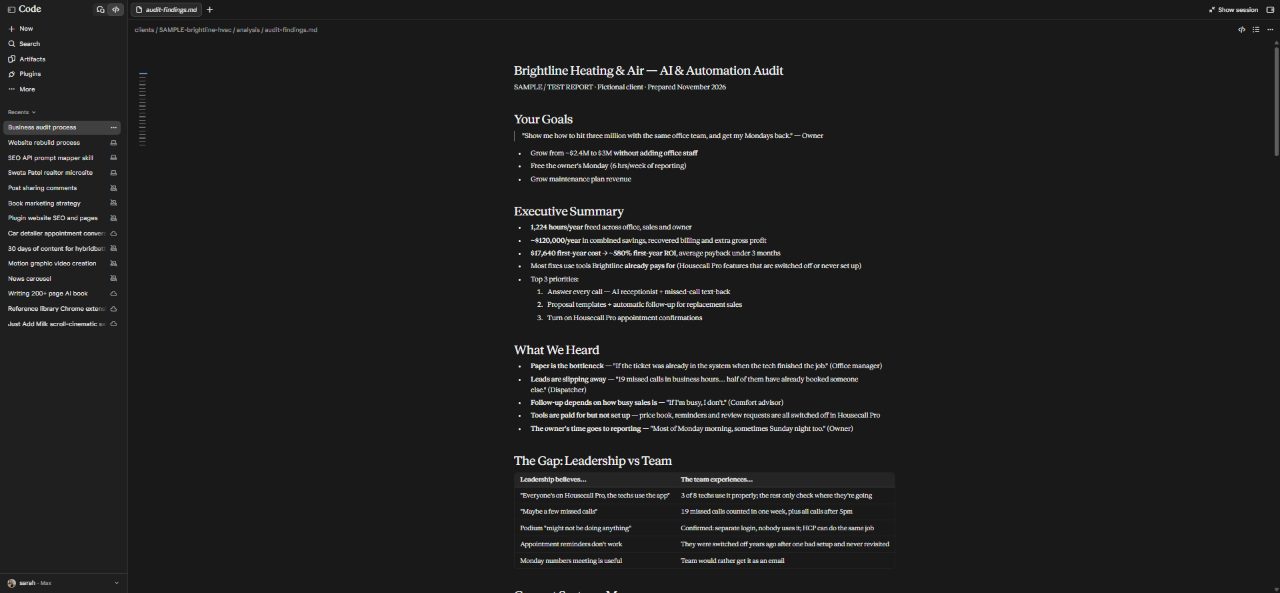
Report title, the owner's goals and quote, and the executive summary with the top three priorities.

The project

Overview

This is a sample AI and automation audit written for Brightline Heating & Air, a fictional HVAC company. The report is labeled "SAMPLE / TEST REPORT" and shows the format a real client would receive: their goals, what their staff said, where their tools are under-used, six ranked opportunities with costed ROI, and a phased roadmap. All dollar figures are modeled for the fictional business, not results from a real one.

The challenge

Small service businesses often pay for software they never fully set up, while staff fill the gaps by hand. The owner usually can't see where the hours go, and the team rarely says so unprompted.

This audit was built around a realistic scenario: an HVAC owner at about $2.4M in revenue who wants to reach $3M without hiring office staff, stop losing Monday mornings to reporting, and grow maintenance plan revenue. The report opens with the owner's own words: "Show me how to hit three million with the same office team, and get my Mondays back."

The client is fictional. The point of the build is to show what a prospect gets from an audit, from start to finish.

What I built

A full written audit report, prepared in Claude Code as a markdown document. It works through the business in a fixed order: goals, an executive summary, staff quotes grouped into themes ("What We Heard"), and a table comparing what leadership believes with what the team experiences. For example, leadership thinks "everyone's on Housecall Pro", while the team reports that 3 of 8 techs use it properly.

It then maps every system the business uses, reviews each tool's monthly cost with a keep, cancel or replace verdict, and lists findings under acquisition, delivery and support. Each finding is tagged as a time sink or a quality risk and credited to the staff member who raised it.

The second half ranks nine ideas on an impact/effort matrix and writes up six in detail. Each one covers the problem, the solution, the tools, the costed impact, first-year cost, ROI, payback time and a score. The report finishes with an ROI summary table, a four-phase roadmap, three ways to proceed (do it yourself, advisory, done for you) and an appendix listing every assumption behind the numbers.
The result

Because the client is fictional, there are no real-world results to report. In the sample scenario, the report models about 1,224 hours a year freed across office, sales and owner, roughly $120,350 a year in combined value, and a $17,640 first-year cost. These are projections built from stated assumptions, not outcomes.

The report is written so an owner can act on it. Most fixes use features the business already pays for, the three top priorities are named up front, and every figure can be traced back to an assumption in the appendix. Close-rate gains are kept deliberately small, for example, and after-hours calls are left out of the numbers because their volume is unknown.

What's inside

Key features

Goals and executive summary up front

The owner's goals and a direct quote appear first, followed by headline hours, dollar value, cost, ROI and the top three priorities, so a busy owner gets the answer in the first screen.

"What We Heard" staff quotes

Findings are grouped into plain themes ("Paper is the bottleneck", "Leads are slipping away"), each backed by a quote attributed to a role such as dispatcher or office manager.

Leadership vs Team gap table

A side-by-side table showing where the owner's view differs from what staff actually do, such as "maybe a few missed calls" against 19 counted in one week.

Current systems map and tech stack review

Every tool is listed with what it does, how it connects to other tools, its monthly cost, user count and a keep, cancel, consolidate or replace verdict.

AI opportunity matrix and costed opportunities

Nine ideas are sorted into Quick Wins, Big Swings, Nice-to-Haves and Deprioritise. Six are written up with problem, solution, tools, impact, cost, ROI and payback.

ROI summary, roadmap and assumptions appendix

A single table totals every opportunity, a four-phase roadmap schedules the work from week 1 to month 12, and an appendix spells out the rates and assumptions behind each number.

Screens

A closer look

Outcomes

What it does for the business

Built with

Claude CodeMarkdown

Want one like this?

Want to know where your hours and paid-for tools are going to waste? I can run this same audit on your business and hand you a costed, step-by-step plan.

Book a free strategy call

Free — no obligations

More case studies

All case studies

Sarah Nayes, owner of connectcraft Ai in Eau Claire, WI

The person behind connectcraft Ai

Hi, I'm Sarah Nayes

I'm in Eau Claire, Wisconsin. The AI does the answering. I do the setup, train it on your business, and I'm the person you call when something needs to change. If AI won't help your business, I'll tell you that too.